
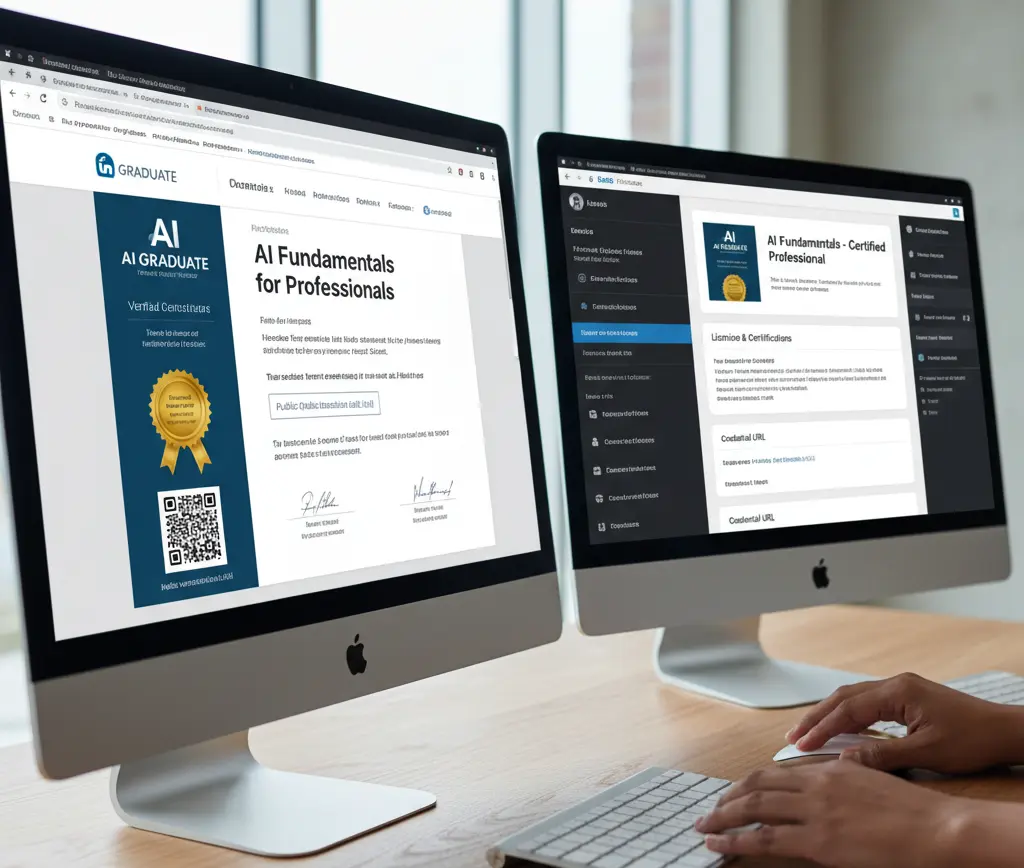
The certificate proliferation problem
Since 2023, the number of organizations offering AI certificates has multiplied dramatically. Some are genuinely useful credentials. Many are not. Professionals who invest time in an AI course deserve to know whether the certificate they receive will actually mean something — or whether it will be quietly ignored by the people they show it to.
The honest answer depends entirely on how the certificate was earned and how it can be verified.
What a weak certificate looks like
Most low-value AI certificates share a recognisable set of characteristics:
- No exam or knowledge check. The certificate is awarded for watching videos or clicking through slides, not for demonstrating understanding.
- No verification URL. The certificate is a static image or PDF with no way for a third party to independently confirm it is real.
- No credential ID. Without a unique identifier, there is no audit trail.
- Paywalled behind expensive courses. Some certificates cost hundreds of dollars but offer no more rigor than a free alternative.
A certificate without verification infrastructure is functionally a self-declaration. It tells an employer you completed something, but gives them no way to confirm it.
A certificate without a verification URL is functionally a self-declaration. It tells an employer you completed something, but gives them no way to confirm it. As AI certifications have proliferated, so has outright fabrication of credentials — verifiable certificates exist specifically to close that gap.
What a strong certificate looks like
A credible AI certificate has the following properties:
- Exam-based. The certificate requires passing a knowledge assessment, not just completing lessons. This means the credential represents demonstrated understanding, not passive consumption.
- Publicly verifiable. A unique URL or credential ID allows anyone — an employer, a client, a recruiter — to confirm the certificate is genuine and who it belongs to.
- Issued by a named organization. The issuing body is identifiable and its certificates can be looked up independently.
- Linked to a specific scope. The certificate specifies what was assessed: AI Fundamentals, Prompt Engineering, AI Strategy, and so on. A certificate that says only "Artificial Intelligence" proves nothing specific.
What a certificate actually signals to employers
When a certificate meets those criteria, it signals something concrete:
- The holder understood the course material well enough to pass an exam.
- The credential can be checked — the holder is not asking anyone to take their word for it.
- The holder invested structured time in developing their AI knowledge, not just experimenting informally.
That combination — demonstrated knowledge, independently verifiable — is what separates a meaningful credential from a participation badge.
When a certificate meets the credibility criteria, it signals three things to an employer: the holder demonstrated assessed knowledge, the credential can be verified without additional effort, and the holder made a deliberate investment in structured AI learning. That combination distinguishes a meaningful credential from a participation badge.
What to look for when choosing a course
Before enrolling in any AI course with a certificate, check three things:
- Does the course include a knowledge exam with a pass threshold?
- Does the issued certificate include a public verification URL?
- Can you find the certificate verification page before you even enrol?
If the answer to any of these is no, weigh that carefully before investing your time.
The courses at Deliberate Academy are built around exactly these requirements: exam-based assessment, certificates with unique credential IDs, and a public verification page at /verify/[certificate-id] that employers and clients can use without an account.