
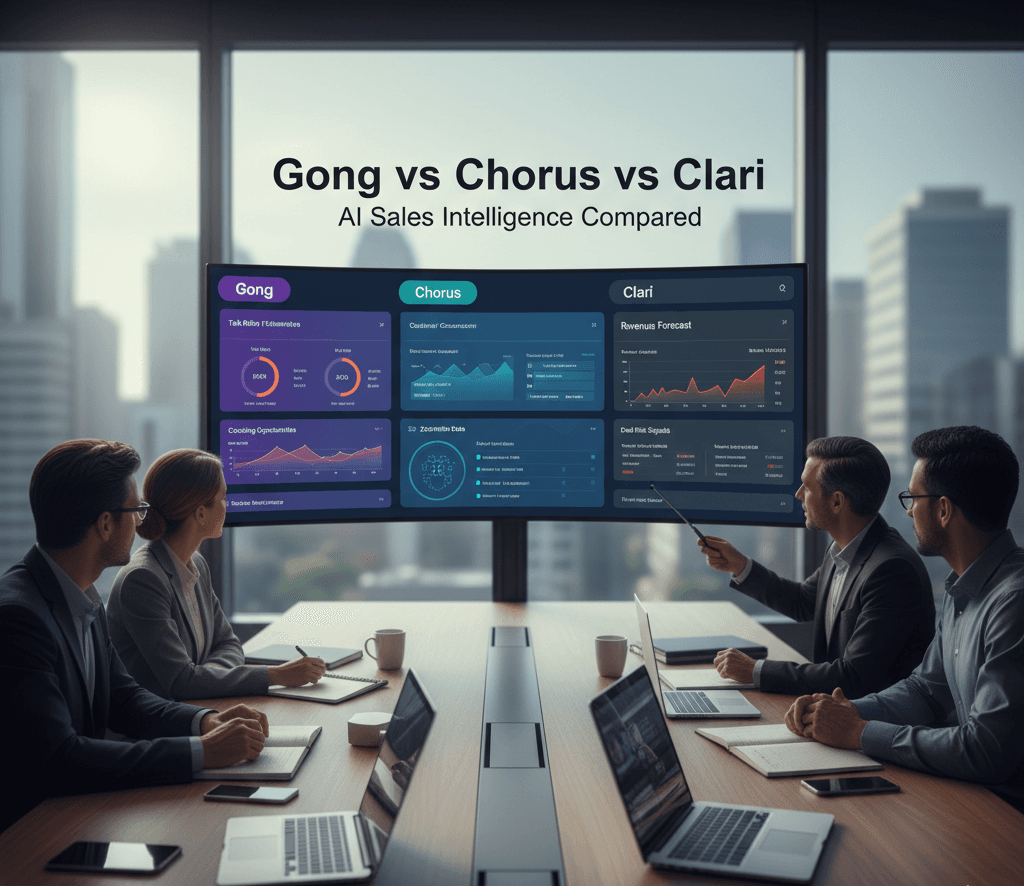
Sales organisations are under pressure to make AI work at the revenue layer — not just in marketing or operations. Gong, Chorus by ZoomInfo, and Clari are the three platforms that come up most often in that conversation. They are not interchangeable. Each was built around a different primary problem, and choosing the wrong one is an expensive mistake to correct.
This comparison is written for sales managers, revenue operations professionals, and revenue leaders evaluating these platforms in 2026. It focuses on what each tool actually does well, where each one falls short, and what your team needs to be in place before any of them deliver value.
What AI sales intelligence tools actually do
Before comparing platforms, it is worth being precise about what this category of software does — because the marketing language tends to obscure meaningful differences.
- Conversation intelligence: Records, transcribes, and analyses sales calls and meetings. Surfaces patterns in talk ratios, question types, objections raised, and topics discussed. The core input is audio and video from live sales conversations.
- Revenue forecasting: Uses pipeline data, deal activity signals, and historical patterns to produce AI-driven projections. Aims to replace or augment the manual forecast roll-up process.
- Deal and coaching intelligence: Identifies at-risk deals, flags coaching opportunities based on rep behaviour, and provides structured guidance for managers. Bridges the data layer to human management decisions.
Gong, Chorus, and Clari each do some or all of these things — but with different depth, different primary orientations, and different assumptions about how your sales process is structured.
Gong
Gong is the most widely adopted conversation intelligence platform in enterprise and growth-stage sales. It was built first around the call recording and analysis problem, and its feature set has expanded significantly from that foundation.
Strengths
Gong's core advantage is the depth of its conversation analytics. It goes well beyond transcription — it tracks talk ratios, questions asked versus answered, competitor mentions, next step commitments, and topic-level patterns across thousands of calls simultaneously. The aggregate insights this generates across a sales org are genuinely difficult to produce by any other means.
Its library functionality is strong. Sales leaders can build searchable libraries of winning calls, objection-handling examples, and deal-specific moments that new reps can learn from. This is one of the more practical implementations of AI-assisted coaching at scale.
Gong's deal intelligence layer has improved substantially. It surfaces deal risk signals based on engagement drop-off, missing stakeholder contacts, and stalled progression — inputs that CRM data alone does not capture.
Weaknesses
Gong is expensive. It is priced for organisations with the budget to support an enterprise-grade toolstack, and per-seat costs compound quickly as team size grows. Smaller teams often find the cost-to-value ratio difficult to justify.
The platform also requires strong adoption discipline from reps. If reps are inconsistent about recording calls, the data quality degrades and the insights become unreliable. Gong does not fix poor process — it amplifies whatever process already exists.
Forecasting in Gong exists but is not its primary strength. Teams that need sophisticated pipeline forecasting alongside conversation intelligence often end up supplementing Gong with a dedicated forecasting layer.
Ideal fit
Gong fits best at growth-stage and enterprise companies with an established outbound or field sales motion, consistent call volume, and a manager layer that has time and willingness to use coaching insights. It performs best when reps sell through structured conversations rather than high-velocity transactional deals.
Chorus by ZoomInfo
Chorus was one of the earliest conversation intelligence platforms before its acquisition by ZoomInfo. The acquisition fundamentally changed its strategic positioning: Chorus is now most valuable for organisations that already use ZoomInfo for prospecting data.
Strengths
Chorus offers solid, functional conversation intelligence. Call recording, transcription, and moment-tagging work reliably. It captures talk ratio data, competitor mentions, and key topic tracking across calls.
The ZoomInfo integration is its clearest differentiator post-acquisition. For teams that use ZoomInfo for contact and account intelligence, Chorus brings that data context directly into conversation review — you can see firmographic and intent data alongside call recordings. This is a meaningful workflow consolidation for teams already inside the ZoomInfo ecosystem.
Chorus also tends to come in at a lower price point than Gong for comparable conversation intelligence functionality, which matters for mid-market teams evaluating both.
Weaknesses
Chorus has not kept pace with Gong on analytics depth, coaching structure, or the quality of deal intelligence signals. Teams that want granular, AI-driven coaching recommendations rather than raw conversation data will find Gong more capable on those dimensions.
The ZoomInfo acquisition introduced integration benefits but also strategic risk. Product investment and roadmap priority sit inside a larger organisation with multiple competing priorities, and the conversation intelligence layer has not received the same independent development velocity it had pre-acquisition.
Chorus also lacks Clari's forecasting depth. If the goal is pipeline visibility and forecast accuracy, Chorus is not the right tool for that problem.
Ideal fit
Chorus fits best for mid-market sales teams that already subscribe to ZoomInfo and want to consolidate vendors rather than manage separate contracts. It is a pragmatic choice when the priority is functional conversation intelligence and ZoomInfo data integration over best-in-class depth in either area.
Clari
Clari is a different category of tool from Gong and Chorus. Its primary problem is revenue forecasting and pipeline management — not conversation intelligence. Understanding this distinction is essential before evaluating it.
Strengths
Clari's forecasting engine is the most capable in the market for organisations with complex, multi-product, multi-segment revenue structures. It aggregates signals from CRM activity, email engagement, call data, and rep-submitted forecasts to produce an AI-driven view of the quarter that is more reliable than manual roll-ups alone.
Its pipeline inspection capabilities are strong. Sales managers can drill into deal progression, identify deals moving slowly through stages, surface accounts with declining engagement, and generate forecast scenarios based on different win assumptions. For revenue leaders who need to manage a board-level forecast conversation, Clari provides the structural layer that most CRMs do not.
Clari also handles the revenue operations workflow well — it gives RevOps teams a platform for running forecast calls, managing commits versus best-case pipelines, and maintaining a structured cadence around forecast hygiene.
Weaknesses
Clari is not a conversation intelligence tool. It does not record or analyse calls. If the primary problem is understanding what reps say on calls, coaching behaviour, or surfacing winning conversation patterns, Clari does not address that.
The platform is also complex to implement and requires clean, disciplined CRM usage to produce reliable outputs. If CRM data is inconsistent — wrong stages, missing close dates, sparse activity logging — Clari's forecasting accuracy degrades significantly. It makes good data better; it does not fix bad data.
Cost is also a consideration. Clari is priced for enterprise and upper-mid-market organisations where the value of improved forecast accuracy is measurable in pipeline volume terms.
Ideal fit
Clari fits best at organisations with significant pipeline complexity, a mature RevOps function, and a revenue leadership team that needs structured, data-driven forecast visibility. It is the right tool when the primary problem is forecast accuracy and pipeline management, not call coaching.
Head-to-head comparison
| Capability | Gong | Chorus | Clari |
|---|---|---|---|
| Conversation intelligence | Best in class | Solid, functional | Not applicable |
| Revenue forecasting | Basic | Basic | Best in class |
| Sales coaching | Strong — structured AI coaching | Moderate — tags moments, less guided | Limited |
| CRM integration | Strong — works across major CRMs | Strong — ZoomInfo data layer adds value | Strong — requires clean CRM discipline |
| Deal risk signals | Good — engagement and activity based | Moderate | Good — pipeline-based signals |
| Price tier | Premium enterprise | Mid-market to enterprise | Premium enterprise |
Which tool fits which team size and motion
Early-stage teams (under 15 reps): None of these three platforms is a natural fit at this stage. The cost and implementation overhead is high relative to the insight value at low call volume. A lightweight recording and transcription tool is a more appropriate starting point. Return to this comparison when team size, pipeline volume, and management structure can actually leverage the data these platforms generate.
Growth-stage teams (15 to 75 reps) with structured sales motion: Gong is the strongest candidate. The coaching and call library functionality provides the highest return at this scale, and the conversation intelligence insights become statistically meaningful as call volume grows. Chorus is worth evaluating as a lower-cost alternative if ZoomInfo is already in the stack.
Mid-market and enterprise teams with forecast complexity: Clari becomes relevant when the pipeline is large enough and the revenue structure complex enough that forecast accuracy is a measurable business problem. Organisations at this stage often run Gong and Clari in parallel — Gong for conversation and coaching intelligence, Clari for pipeline forecasting. These tools are not direct competitors for this buyer.
Teams inside the ZoomInfo ecosystem: Chorus offers a consolidation opportunity that is worth evaluating on pure commercial grounds, independent of feature depth comparisons with Gong.
What these tools require from sales reps to work well
Every one of these platforms depends on consistent rep behaviour to generate useful data. This dependency is frequently underestimated during evaluation.
For Gong and Chorus, reps must record calls consistently. Unrecorded calls leave gaps in the dataset that undermine coaching insights and pattern analysis. Managers must also engage with the platform — pulling clips, leaving comments, running coaching sessions — or the tool becomes an expensive recording library that nobody uses.
For Clari, the dependency is CRM discipline. Deal stages must be kept current, close dates must be maintained, and activity must be logged reliably. Clari can only surface accurate risk signals from accurate input data. If your CRM hygiene is poor, Clari will make that problem visible but will not resolve it.
Before signing a contract with any of these platforms, audit your team's current behaviour on the specific inputs the tool requires. If call recording adoption is below 70 percent, or if CRM stage accuracy is inconsistent, address those process problems first. Buying the tool before fixing the behaviour is a reliable path to low ROI on a significant investment.
Why tool adoption depends on AI-literate sales teams
The organisations that extract the most value from Gong, Chorus, and Clari share a common characteristic: their sales managers and revenue leaders understand how to interpret AI-generated signals rather than defer to them uncritically.
A Gong risk score on a deal is not a verdict — it is a signal that warrants a conversation. A Clari forecast projection is not the forecast — it is an input to a human judgment. Managers who treat AI outputs as facts to be acted on without interrogation make worse decisions than managers who understand what the AI is measuring and what it cannot see.
This is not a theoretical concern. Sales teams that have invested in structured AI tools without investing in AI literacy in their management layer consistently report lower ROI. The platforms surface real patterns, but acting on those patterns well requires managers who understand what the data does and does not represent.
For sales professionals who want to build that foundational understanding, the AI for Sales course at Deliberate Academy — which is free and takes under two hours — covers how AI systems work in sales contexts — what signals they measure, how forecasting models make predictions, and how to use AI-generated insights without displacing the judgment calls that AI cannot make. The AI tools professionals use article also covers how conversation intelligence and revenue tools fit into broader professional AI workflows.
Teams that skip this investment tend to find that their AI tools become expensive CRM integrations rather than genuine capability multipliers.
Gong, Chorus, and Clari are serious enterprise tools that solve real problems when deployed correctly. None of them compensates for weak process, poor CRM discipline, or a management layer that is not equipped to act on AI-generated signals. If you want to build the foundational AI literacy that makes these platforms actually deliver on their promise, the AI for sales course at Deliberate Academy covers what sales professionals need to understand to use AI tools with confidence — at the rep level and the manager level alike. It is free, takes less than two hours, and issues a verifiable certificate on completion.